

Training is a MUST
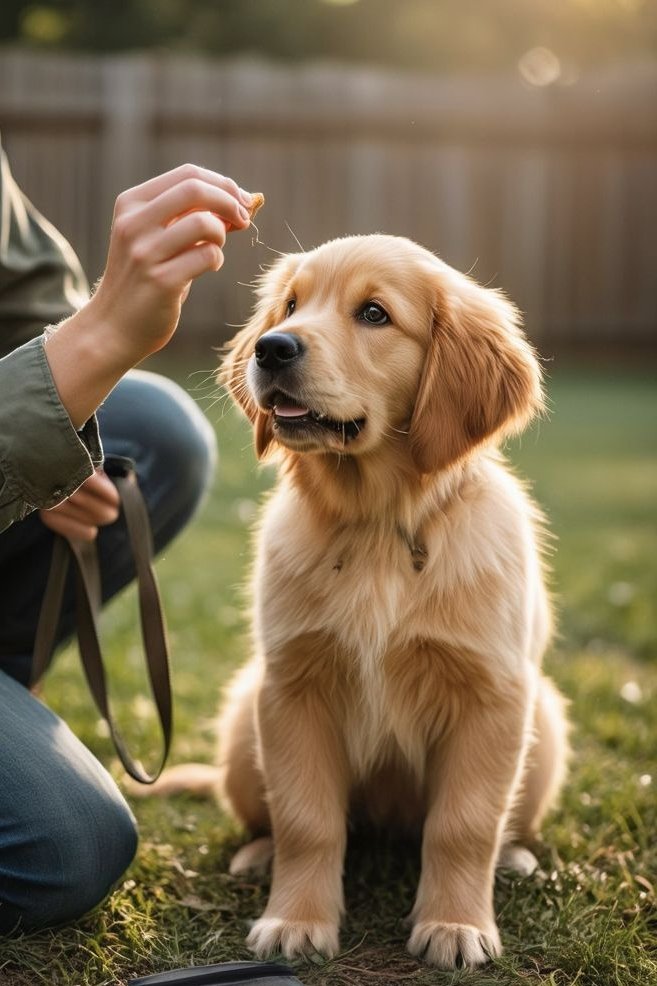
Effective puppy training is essential for establishing a well-behaved and mentally stimulated companion. Puppies require guidance and instruction from an early age to develop proper manners and social skills. Training serves not only to teach basic commands such as sit, stay, and come, but also to foster a strong foundation for a positive and communicative relationship between owner and pet. It facilitates mutual understanding, ensuring that the puppy comprehends expectations and boundaries. Moreover, consistent training enhances the puppy’s cognitive development and promotes behavioral stability, which is crucial for their overall well-being. Engaging training sessions should be approached with patience and perseverance, as these qualities significantly influence the learning process. The process of training can be rewarding, providing opportunities to observe rapid progress and to strengthen the bond with the puppy. Ultimately, a well-trained puppy is not only more manageable but also more enjoyable to be around, contributing to a harmonious household environment.
Understanding Puppy Behavior
Puppy behavior is deeply rooted in natural instincts that play an essential role in their development and socialization. When puppies greet people by jumping up, they exhibit a behavior that usually stems from their innate desires for attention, affection, and play. This jumping is a manifestation of their exuberance and eagerness to engage with those around them. Such behaviors, while perceived as cute by many, can lead to complications in interactions if not guided appropriately.
It is crucial to recognize that puppies learn through their interactions with their environment and the beings in it. They are highly responsive to the feedback they receive from humans. For instance, when a puppy jumps up and receives positive reinforcement such as petting or vocal excitement, it reinforces the idea that this behavior is desirable. Conversely, if the puppy is reprimanded for jumping, the confusion can lead to further problematic behaviors. This is where early training becomes indispensable.
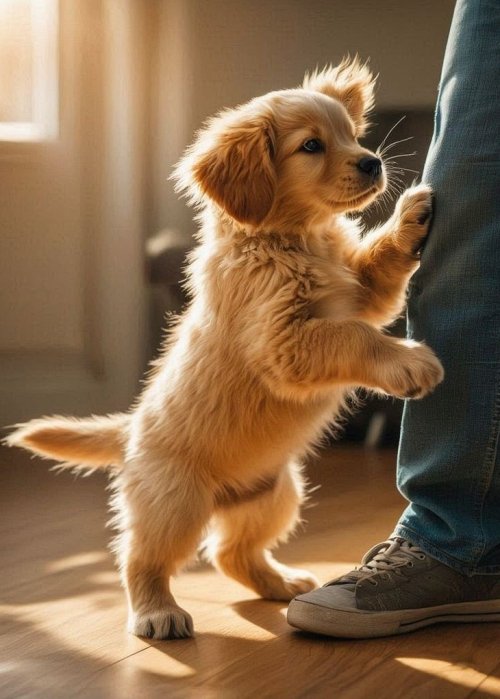
Establishing clear boundaries and consistently teaching acceptable behaviors can significantly shape a puppy’s response.
The psychological aspects of puppy behavior also play a vital role in understanding why jumping occurs. Puppies are creatures of habit, and their actions are often conditioned responses to their surroundings. Jumping can be a learned behavior stemming from both positive and negative interactions, making it essential for pet owners to be mindful of their reactions. The right approach involves redirecting the energy that drives jumping, instead guiding them towards behaviors that are more acceptable in various social situations. Using methods like positive reinforcement and consistent training, pet owners can help modify this behavior effectively, ensuring healthier interactions in the long term.

Establishing Rules and Consistency
Establishing rules and consistency is paramount in managing jumping behavior in puppies. To create a well-mannered pet, it is essential to set clear boundaries that everyone in the household understands and adheres to. This includes not only the puppy owner but also all family members and visitors. By maintaining a united front, the puppy can more effectively learn what behaviors are acceptable and which are not.
One of the foundational steps in communicating the rules is to ensure that everyone involved knows the specific behaviors that are permitted. For instance, if the goal is to deter jumping, it is crucial for all household members to refrain from encouraging such behavior, even inadvertently.
Strategies to Prevent Habitual Jumping in Puppies
To effectively prevent your puppy from developing a jumping habit, it is essential to implement one of two consistent actions whenever the behavior occurs. Consistency in applying these methods will reinforce desired behaviors and discourage unwanted jumping.
Method 1: Step Back and Reinforce Calm Behavior
- Once your puppy is standing with all four paws on the floor, bend down to offer calm, affectionate attention. This should be gentle and composed, emphasizing a relaxed demeanor rather than excitement.
- When your puppy jumps, take a step backward or sideways to remove yourself from their immediate reach.
- Refrain from giving any form of attention—no talking, touching, or eye contact—until the puppy has all four paws on the ground.
Method 2: Stand Still and Ignore
- If your puppy jumps on you, simply stand still without reacting in any manner.
- Do not talk, touch, look at, or otherwise acknowledge the puppy.
- Wait patiently until the puppy places all four paws on the ground.
- When this occurs, reward with calm and gentle attention to reinforce appropriate behavior.
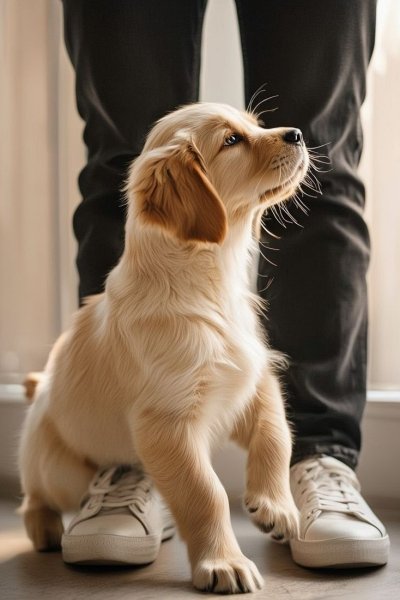
When a puppy begins to jump in response to attention, it is advisable to cease all interaction immediately. Refrain from speaking, pushing away, or making eye contact. Instead, withdraw your attention entirely and calmly step back until the puppy ceases the unwanted behavior and resumes calmness. This approach helps reinforce appropriate behavior through consistent and non-rewarding responses, promoting better discipline and understanding in the puppy’s training process. Consistent application of these method will gradually teach your puppy that jumping does not result in attention or excitement, thereby reducing the likelihood of forming this undesirable habit.
Start with Sit
Training a puppy or dog to sit should be approached with patience and positive reinforcement techniques whenever possible. With the training of “sit.” Positive reinforcement training is all that is ever needed. As a result, instead of applying physical pressure by pushing down on the hindquarters, it is recommended to use a treat as a guiding tool. Pushing on the pup’s behind can cause joint issues and is never necessary. Instead, use a treat as a training tool.
Training to Sit

Hold a treat above the pup’s nose and slowly move it in an arc over the head, from the nose to behind the ears. This motion encourages the puppy to naturally sit as it follows the treat. When the puppy assumes the sitting position, immediately reward with the treat to reinforce the behavior. Repeat this process consistently over several days to establish a clear association.
Once the puppy reliably sits in response to the treat, you can introduce variability in rewards, often referred to as “lottery treats.” This involves occasionally rewarding the puppy with a treat and other times offering verbal praise such as “good dog” or similar affirmations. This method maintains the puppy’s interest and motivation without over-reliance on treats. It is important to maintain a calm and steady demeanor during training sessions. Avoid excitement or raising your voice, as a composed tone helps the puppy focus on the task.
While verbal commands are optional, I am not one that chooses to use a verbal cue for this action, instead, I use a hand gesture. However, many find that associating a specific word with the action, such as “sit,” can be beneficial once the behavior is well established. Additionally, if you feed your puppy on a regular schedule, it is advantageous to have the puppy sit before receiving food. This practice reinforces the command and integrates training into daily routines, promoting better obedience and understanding of commands in various contexts.
Reinteration of Proper Potty Training
Potty training a puppy requires consistent and appropriate techniques to ensure effective learning. It is essential to recognize that reprimanding a puppy for accidents when not caught in the act is ineffective. Instead, focus on positive reinforcement and proper management strategies. Avoid punitive actions such as rubbing a puppy’s nose in messes or wet areas, as these methods are not only unproductive but also potentially harmful to the puppy’s emotional well-being. Such actions are comparable to inappropriate disciplinary measures with young children and can lead to confusion and fear in the puppy.
When a puppy has an accident indoors, the appropriate response is to thoroughly clean the area to eliminate odors that might encourage repeat behavior and then go about your day. If you observe the puppy in the act of urinating or defecating, immediately make a noise to alert the puppy, gently pick them up, and promptly take them to the designated potty area. Once the puppy completes their business, provide calm and consistent praise to reinforce the desired behavior. It is advisable to praise quietly during the act and to give enthusiastic praise once the puppy has finished, as overly excited reactions during the act may cause the puppy to stop.
During outdoor potty breaks, maintain a calm demeanor and avoid engaging the puppy in play or interaction until they have finished their business. Excessive attention during this time can prolong the process. Instead, remain quiet, avoid direct eye contact, and use a calm verbal cue such as “go potty” to encourage the behavior. If the puppy resists moving from your side, walk slowly and allow them to explore the environment without forcing them. After the puppy successfully eliminates, allow them to re-enter the house calmly, following your lead. It is important not to pick up the puppy immediately after they finish, as this can interfere with their understanding of the routine.
Consistent outdoor routines are vital for successful potty training. Encourage the puppy to follow you outside for regular potty breaks, avoiding carrying them outside to promote independence. Recognize signs that the puppy needs to go out, such as lingering near the door, and proactively open the door to facilitate the behavior. Even if the puppy does not need to go, this practice reinforces the association between the door and the opportunity to go outside. Implementing these strategies with patience and consistency will support effective potty training and foster a positive learning environment for the puppy.
Affirmative Training is not ALWAYS the Answer
With over 35 years of experience working with dogs, I recognize that certain training approaches, particularly those emphasizing affirmation, can sometimes lead to unintended consequences. It is important to understand that excessive coddling or overindulgence can hinder a dog’s development and behavior. As a trainer and handler, it is essential to establish yourself as the leader, rather than allowing the dog to assume a dominant or overly dependent role.
When a puppy exhibits undesirable reactions, such as unnecessary screaming or resistance, responding with excessive reassurance may inadvertently reinforce these behaviors, prolonging their duration. A significant proportion of behavioral issues presented to me—approximately 85%—are often the result of inconsistent or misguided training by the dog’s human companions.
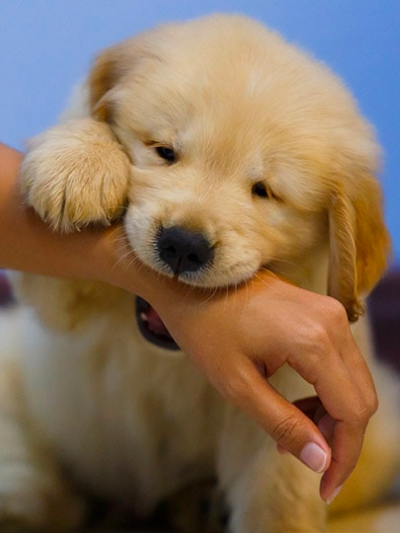
While I support positive reinforcement methods, it is crucial to recognize that dogs, much like young children, sometimes require clear boundaries and discipline to ensure proper behavior. For example, when a two-year-old child is playing with a dangerous object like a fork near a power socket, a rational parent would respond swiftly and assertively—either by removing the object or reprimanding the child—to prevent harm. This immediate action is driven by the necessity to ensure safety, not by anger or harshness. A resonable adult is not going to tell a two-year old human, “Hey, do not do that you may get hurt.” This does not make sense. Just as if a puppy/dog is consistantly biting someone, telling them that it is ok or trying to soothe them is not going to get you the results you want. As a result, when training your puppy, timely and appropriate correction is necessary to communicate boundaries effectively. It is vital to balance affirmation with discipline to foster well-mannered and confident dogs.
It is important to clarify that establishing leadership does not equate to being punitive or aggressive. The goal is to maintain control through consistent, fair, and respectful training practices. Proper manners and social etiquette are essential for a well-behaved dog, and they should be reinforced through appropriate training techniques. If you have concerns or questions about your training methods, I encourage you to contact me directly. Please note that I do not provide training advice via text messages. However, I will be more than happy to TALK to you about it over the phone and help you in any way that I can. If a situation requires further assistance, I will advise you to schedule an in-person session with me or consult with a qualified trainer of your choice to ensure your dog’s training is effective and humane.
Last note: I AM ALWAYS HERE FOR YOU. PLEASE contact me if you have any questions or concerns with you new family member.